
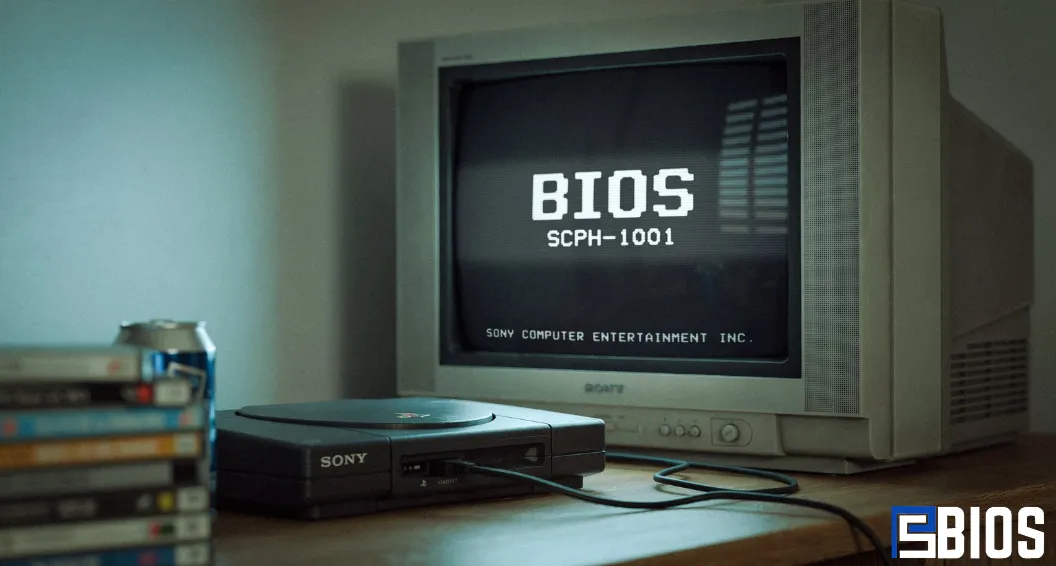
PS1 BIOS SCPH1001.bin (PSX) is one of the most widely used PlayStation BIOS files for PS1 emulators. It enables emulators like DuckStation, ePSXe, RetroArch, and Mednafen to accurately replicate the original PlayStation console, improving game compatibility, performance, and stability. If you’re experiencing startup errors, black screens, or save issues, using the correct BIOS file can help ensure a smoother and more authentic PS1 gaming experience.
What Is PS1 BIOS SCPH1001.bin (PSX)?
PS1 BIOS SCPH1001.bin (PSX) is the original firmware of the Sony PlayStation (PS1). It allows emulators to replicate the console’s hardware, handling tasks like system startup, memory card detection, controller initialization, and game loading. Thanks to its excellent compatibility, SCPH1001.bin is one of the most recommended BIOS files for playing NTSC-U (USA) PlayStation games accurately.
Uses of PS1 BIOS SCPH1001.bin (PSX)
The PS1 BIOS SCPH1001.bin (PSX) is used to make PlayStation emulators function like the original PS1 console. Its main uses include:
- Runs PS1 games with higher compatibility.
- Displays the original PlayStation boot screen.
- Improves graphics, audio, and game performance.
- Supports memory cards and saves files.
- Reduces crashes, glitches, and emulator errors.
- Works with popular emulators like DuckStation, ePSXe, and RetroArch.
- Provides a more authentic PlayStation gaming experience.
Although the file is small, it plays a critical role in accurate PlayStation emulation.
Why Is PS1 BIOS SCPH1001.bin (PSX) So Popular?
Many BIOS versions exist for the PlayStation, but the PS1 BIOS SCPH1001.bin (PSX) remains the first choice for many gamers.
There are several reasons why it is widely recommended.
Excellent Compatibility
Most PlayStation emulators are optimized for SCPH1001.bin. It works with thousands of PS1 games without requiring additional configuration.
Stable Performance
Games generally load faster and experience fewer crashes when a genuine BIOS is used instead of a built-in HLE (High-Level Emulation) BIOS.
Better Game Accuracy
The BIOS reproduces the behavior of the original PlayStation hardware. This improves graphics, sound, timing, and controller support.
Memory Card Support
Using the correct BIOS reduces save-game issues and helps virtual memory cards function correctly.
Improved Boot Process
Players can enjoy the original PlayStation startup logo and animation before launching games.
PS1 BIOS SCPH1001.bin (PSX) File Details
Below are the basic specifications of PS1 BIOS SCPH1001.bin (PSX).
| Feature | Details |
| File Name | SCPH1001.bin |
| Console | Sony PlayStation (PS1 / PSX) |
| Region | USA (NTSC-U) |
| File Format | .BIN |
| File Size | Approximately 236 KB |
| Compatible With | DuckStation, ePSXe, RetroArch, Mednafen, PCSX-Reloaded |
| Platforms | Windows, Linux, macOS, Android |
| Firmware Type | Original PlayStation BIOS |
What Does PS1 BIOS SCPH1001.bin (PSX) Actually Do?
Many beginners think the BIOS simply starts the game.
In reality, it performs several important system functions before gameplay even begins.
These include:
- Initializing PlayStation hardware
- Detecting controllers
- Loading memory cards
- Preparing graphics hardware
- Starting audio processing
- Reading the game disc or ISO
- Launching the PlayStation boot animation
- Handing control to the game
Without these operations, many games cannot run correctly.
Why Do Emulators Need PS1 BIOS SCPH1001.bin (PSX)?
The PS1 BIOS SCPH1001.bin (PSX) helps emulators accurately recreate the original PlayStation hardware. While some emulators use a built-in HLE BIOS, the original BIOS offers better compatibility, improved performance, fewer crashes, accurate audio, proper memory card support, and smoother gameplay. For the best PS1 emulation experience, using the original BIOS is recommended.
Key Features of PS1 BIOS SCPH1001.bin (PSX)
PS1 BIOS SCPH1001.bin (PSX) offers several features that improve PlayStation emulation and deliver a more authentic gaming experience:
- Original Boot Screen – Displays the classic PlayStation startup animation.
- High Compatibility – Supports thousands of PS1 games across popular emulators.
- Accurate Emulation – Replicates the original PlayStation hardware for smoother gameplay.
- Reliable Save Support – Works with virtual memory cards to prevent save issues.
- Improved Audio – Enhances sound quality and cutscene synchronization.
- Region Support – Optimized for NTSC-U games while supporting many multi-region emulator setups.
Which Emulators Support PS1 BIOS SCPH1001.bin (PSX)?
PS1 BIOS SCPH1001.bin (PSX) is supported by most modern PlayStation emulators, including DuckStation, ePSXe, RetroArch (Beetle PSX Core), Mednafen, PCSX-Reloaded, XEBRA, and BizHawk. Using the BIOS with these emulators improves compatibility, accuracy, and overall gameplay.
Benefits of Using PS1 BIOS SCPH1001.bin (PSX)
Installing the correct BIOS offers several advantages over using an emulator’s built-in firmware.
Here are the biggest benefits.
- Faster game startup
- Better compatibility
- Improved stability
- Original PlayStation experience
- Accurate controller support
- Reliable save files
- Reduced graphical glitches
- Better audio quality
- Smoother FMV playback
- Fewer emulator errors
For most users, installing the BIOS only takes a few minutes, but greatly improves overall gameplay
Is PS1 BIOS SCPH1001.bin (PSX) Better Than HLE BIOS?
Yes, in most situations.
HLE BIOS is designed for convenience, but it doesn’t perfectly reproduce PlayStation hardware behavior.
Here’s a quick comparison.
| PS1 BIOS SCPH1001.bin | HLE BIOS |
| Original Sony firmware | Emulator-created firmware |
| Higher compatibility | Lower compatibility |
| Better game accuracy | Some games may fail |
| Original boot logo | Usually skipped |
| Stable saves | Can have save issues |
| Recommended by most emulator developers | Mainly for testing |
For the best gaming experience, PS1 BIOS SCPH1001.bin (PSX) remains the preferred choice.
PS1 BIOS Versions and Regions
Sony released several PS1 BIOS versions for different regions, including the USA (NTSC-U), Europe (PAL), Japan (NTSC-J), and Asia. While SCPH1001.bin is the most popular choice for North American games, using the BIOS that matches your game’s region can improve compatibility and reduce language, timing, or video issues. Most modern emulators also support multiple BIOS files and can automatically select the appropriate version.
Which PS1 BIOS Version Should You Use?
Many users ask whether they should choose SCPH1001.bin, SCPH5501.bin, or another version.
For most players, PS1 BIOS SCPH1001.bin (PSX) remains the best option because it offers excellent compatibility with popular emulators and thousands of PlayStation games.
Here are some general recommendations:
- SCPH1001.bin – Best for USA games.
- SCPH1002.bin – Recommended for PAL releases.
- SCPH5500.bin – Ideal for Japanese games.
- SCPH5501.bin – Good alternative for NTSC-U titles.
If your emulator supports automatic BIOS switching, you can store multiple BIOS files in one folder and let the emulator choose the appropriate version.
How to Install PS1 BIOS SCPH1001.bin (PSX)
Installing PS1 BIOS SCPH1001.bin (PSX) is quick and only needs to be done once.
Step 1: Extract the downloaded BIOS archive until you see SCPH1001.bin.
Step 2: Create a folder named bios inside your emulator directory (if one doesn’t already exist).
Step 3: Copy SCPH1001.bin into the bios folder. Keep the original filename.
Step 4: Open your PS1 emulator, go to BIOS Settings, and select the bios folder.
Step 5: Save the settings, restart the emulator, and launch your game. If everything is set up correctly, you’ll see the classic PlayStation startup screen before the game loads.
How to Use PS1 BIOS SCPH1001.bin (PSX) in DuckStation
Step 1: Open DuckStation.
Step 2: Go to Settings → BIOS.
Step 3: Select the folder containing SCPH1001.bin.
Step 4: Choose SCPH1001.bin from the detected BIOS list.
Step 5: Click Apply and restart DuckStation.
Step 6: Launch your PS1 game. If the BIOS is configured correctly, the classic PlayStation startup logo will appear before the game loads.
How to Set Up PS1 BIOS SCPH1001.bin (PSX) in RetroArch
Step 1: Close RetroArch.
Step 2: Copy SCPH1001.bin into the system folder inside the RetroArch directory.
Step 3: Open RetroArch and load the Beetle PSX or SwanStation core.
Step 4: Launch a PlayStation game. If the BIOS is detected, RetroArch will use it automatically.
Step 5: If the BIOS isn’t found, go to Settings → Directory → System and verify that the folder path points to the correct BIOS location.
How to Configure PS1 BIOS SCPH1001.bin (PSX) in ePSXe
Step 1: Open ePSXe.
Step 2: Go to Config → BIOS Settings.
Step 3: Browse to the folder containing SCPH1001.bin.
Step 4: Select the BIOS file and save your settings.
Step 5: Restart ePSXe and launch your PS1 game. If the PlayStation startup logo appears, the BIOS is configured correctly.
Common Installation Mistakes
Simple setup errors cause most BIOS issues.
Avoid these common mistakes:
- Renaming the BIOS file – Keep the filename as SCPH1001.bin.
- Using the wrong folder – Make sure the BIOS is placed in the correct directory and selected in your emulator.
- Using a corrupted BIOS file – A damaged file can cause crashes or black screens.
- Mismatched BIOS region – Use a BIOS version that matches your game’s region for the best compatibility.
Troubleshooting PS1 BIOS SCPH1001.bin (PSX)
Even after installation, some users may encounter problems.
Here are the most common issues and their solutions.
Emulator Says “BIOS Not Found”
Check that SCPH1001.bin is inside the correct BIOS folder.
Verify the BIOS path in your emulator settings.
Restart the emulator after saving changes.
Black Screen After Launching a Game
This usually happens when:
- The BIOS isn’t selected.
- The BIOS file is corrupted.
- The game image is damaged.
Try another game to determine whether the issue is with the BIOS or the game file.
PlayStation Logo Doesn’t Appear
If the game starts instantly without showing the PlayStation startup screen, your emulator may be using an internal HLE BIOS instead of the PS1 BIOS SCPH1001.bin (PSX).
Check the BIOS settings and select the original BIOS manually.
Save Files Are Missing
If your saves disappear, inspect your virtual memory card settings.
Create a new memory card if the existing one is corrupted.
Using a stable BIOS like SCPH1001.bin can help reduce save-related issues.
Audio or Video Problems
If cutscenes lag or sound becomes distorted:
- Update your emulator.
- Use the latest graphics renderer.
- Match the BIOS region to the game.
- Check your audio synchronization settings.
These simple steps solve most playback problems
Conclusion
PS1 BIOS SCPH1001.bin (PSX) is the best choice for accurate and stable PlayStation emulation. It improves compatibility, performance, save support, and delivers the authentic PS1 startup experience across popular emulators like DuckStation, ePSXe, and RetroArch. For the best PS1 gaming experience in 2026, using the correct BIOS is highly recommended.
Frequently Asked Questions
1. What is PS1 BIOS SCPH1001.bin (PSX)?
It is the original PlayStation firmware used for accurate PS1 emulation.
2. Do I need PS1 BIOS SCPH1001.bin?
No, but it offers better compatibility and performance than an HLE BIOS.
3. Which emulators support it?
DuckStation, ePSXe, RetroArch, Mednafen, PCSX-Reloaded, BizHawk, and XEBRA.
4. Can I use it on Android?
Yes. Emulators like DuckStation and ePSXe support it.
5. Why isn’t my emulator detecting the BIOS?
Ensure SCPH1001.bin is in the correct BIOS folder and selected in your emulator settings.
